AI data centers and the climate: the middle ground is real, and the AI companies can't reach it alone
Data centers are a small share of global power but a big local load. The middle ground is flexible demand, new clean power and per-site water numbers.
Not today’s newsNot today's news. Google, Amazon and Microsoft all reported record emissions this summer, but the pattern is two years old and the 2030 pledges haven't moved. Why write it now: India is about to build most of its capacity with no binding national policy.

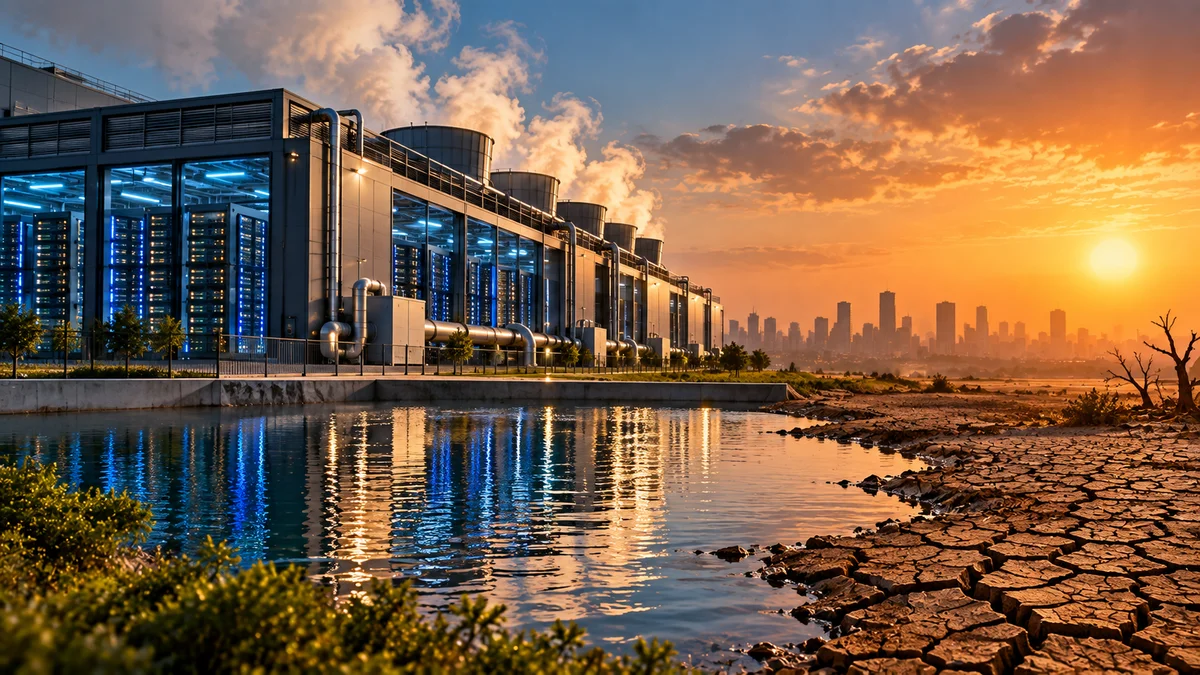
Both sides of this argument are using true numbers, which is why it never ends.
What the numbers say
The International Energy Agency says data center electricity demand grew 17% in 2025, and demand from AI-focused data centers grew 50%. Global electricity demand grew 3%. Its central projection has data centers going from about 485 TWh in 2025 to about 950 TWh in 2030. That’s roughly 3% of global demand. Their emissions roughly double to about 350 million tons by 2035, which the IEA puts at around 2% of electricity-sector emissions.
So the share is small. The IEA also estimates that if every ordinary web search were replaced by an AI text query, it would use under 4 TWh a year. The line that your chatbot prompts are cooking the planet is weak.
The company numbers are not small. Google reported emissions up 18% in 2025, the biggest annual rise it has reported. Amazon reported 16%. Microsoft reported 25%, and part of that came from a decision to stop counting renewable energy certificates that weren’t tied to a specific project. Its market-based scope 2 figure went from about 258,000 tons to about 2.7 million. Microsoft’s report says its sustainability solutions are not scaling fast enough to meet demand. It also says it matches all of its annual electricity use with renewables, through on-site generation, power purchase agreements and other long-term contracts. Google is aiming for net zero by 2030, Amazon by 2040, and Microsoft for carbon negative by 2030.
Both things hold at once. Globally it’s a modest share growing fast. Locally it’s a very large load arriving in one place, on a deadline.
Where it lands in India
CEEW puts India’s installed data center capacity at about 520 MW in 2020 and about 1.5 GW in 2025, and projects 4.5 to 6.5 GW by 2030. CEEW also cites an estimate of about 150 billion liters of water use a year, from a market-research firm, and expects that to more than double by 2030.
Water numbers are where the public record gets thin. In Thane, a municipal official was reported as saying 12 million liters a day of treated sewage water would go to a proposed Amazon data center. Amazon later said the site would use no water for cooling and that its approved supply of 0.01 million liters a day is for staff. The two statements may describe different stages of the project, and that’s the problem. There’s no single public water balance to check them against, and India has no binding national data center policy. Fifteen states have policies or related frameworks, and only five of them include explicit sustainability provisions.
What the middle ground looks like
I think there are three parts, and none of them is “build less” or “trust the pledge.” The first is not my idea. The IEA’s own policy advice points the same way.
Connect faster, in exchange for flexible demand. Slow grid connections are what push developers toward on-site gas turbines. The IEA found that reliable on-site gas for a swinging AI load means overbuilding the plant by 30% to 70%. A Duke University study, as reported by Utility Dive, found that cutting data center peak demand by just 1% to 2% could lower electricity rates by 0.5% to 2.8%. In June, FERC ordered six US grid operators to justify or reform their large-load rules, including new transmission service for flexible loads. By the second quarter, utilities had 69 approved large-load tariffs, and about a quarter of the 104 tracked include a real option to curtail. Google has said it will shift non-urgent computing for some utilities when the grid is stressed.
It isn’t settled. Utility Dive reports that the missing piece is a standard binding agreement. Utilities want control over the load, and data center operators resist giving it. The deal is speed for flexibility, and the fight is over who holds the switch.
Power that is new, and matched by the hour. An annual certificate can make a data center look clean while it runs on whatever the grid has at 9 p.m. Microsoft’s own change shows how much that matters. Companies should report location-based emissions next to the market-based ones, and say how much of their load is covered hour by hour. CEEW says renewable developers see up to about 80% renewable supply as feasible with battery storage, and some operators have already committed to hourly matching.
Water and siting numbers, per site, before approval. Not a company-wide average after the fact. A city deciding on a data center should know the expected daily draw and where it comes from.
Who has to help
The AI companies can’t get there alone, because the things they want and the things the public wants are both decided by other people.
- Grid regulators and utilities write the tariffs that make flexible connection possible. Without them, on-site gas is the only fast option.
- State governments in India decide the water source and the permit conditions. Rajasthan’s 2025 policy requires wastewater recycling and zero liquid discharge. CEEW calls it the most complete sustainability framework among the states, and other states can copy or tighten it.
- The companies have to publish per-site numbers and sign the curtailment agreements. They’ve shown they’ll do this when it’s required or when it saves time. Mostly it has to be one of those two.
My read is that the middle ground exists in the numbers. It costs the companies some speed or some flattering accounting, and so far they’ve given up either only when someone required it.
Caveats
On-site gas has had its own fights. In April the NAACP sued xAI, alleging it ran 27 gas turbines for its Colossus 2 data center in Southaven, Mississippi without an air permit. Mississippi regulators had treated the turbines as temporary and mobile, and the suit says that exemption doesn’t exist. That’s an allegation, not a finding. Forecasts also vary a lot: the IEA’s 2025 report puts demand in 2035 anywhere from 700 to 1,700 TWh.
SourcesIEA, Energy and AI ↗IEA, Key Questions on Energy and AI ↗Axios ↗ESG Dive (Microsoft) ↗ESG Dive (Amazon) ↗CEEW ↗The Wire ↗Utility Dive ↗DSIRE Insight ↗Foley & Lardner (FERC) ↗Mississippi Today ↗
Companies get a cleaner-looking number from loose certificates and a faster connection from on-site gas. Neighbors get the air permits, the water draw and the grid upgrade bills. Nothing here changes until a regulator asks for it.
The operator’s readI've spent eleven years in product, not engineering, so this is a product read.
A sustainability report is a product, and the company picks the metric. Microsoft changed what it counted and one line went up about tenfold. When a headline number moves because of accounting, ask what it's a count of.
Swami Guru · Eleven years leading productSkip the 2030 pledges as a guide to what any AI company is doing. Look for three things instead: hourly-matched power, water numbers per site, and a signed agreement with a utility to cut demand when the grid is tight. Until a company shows those, its net-zero line is unproven.